
a blazing summer afternoon in Delhi, your air conditioner running at full blast, and yet your electricity bill doesn’t make your heart skip a beat. Sounds like a dream? That’s the solar-powered reality thousands of Indian homes and businesses are waking up to.
The solar energy revolution in India isn’t just about cutting costs; it’s about independence, sustainability, and smart investment. But with countless panels, brands, and promises flooding the market, how do you actually choose the right solar solution for your specific needs? Let’s break it down, smartly, sustainably, and with a little sunshine logic.
Step 1: Understand Your Power Needs
Before investing in any solar system, you need to know how much power you use. The formula is simple but powerful: Know your consumption before choosing your conversion.
Start by analyzing your monthly electricity bill, check the average units (kWh) you consume. Residential users in cities like Pune or Bengaluru might need a 3–5 kW solar system, while a small business or factory could require 10–50 kW depending on load.
Tip: Use a simple spreadsheet to calculate your average monthly usage. Multiply your daily consumption by 30 to get a realistic estimate.
Solar Energy Needs by User Type
| Type of User | Average Daily Usage (kWh) | Recommended Solar Capacity (kW) | Expected Monthly Savings (₹) |
| Apartment Resident | 8–10 | 3–4 | 3,000–4,000 |
| Independent House | 15–20 | 5–6 | 6,000–8,000 |
| Small Business | 40–60 | 10–15 | 15,000–20,000 |
| Medium Enterprise | 100–150 | 25–40 | 30,000–40,000 |
| Industrial Unit | 300+ | 50+ | 75,000+ |
Step 2: On-Grid, Off-Grid, or Hybrid — Which One Fits You?
Choosing between on-grid, off-grid, and hybrid solar systems can feel like standing at a crossroads. Let’s simplify the choice with a relatable scenario:
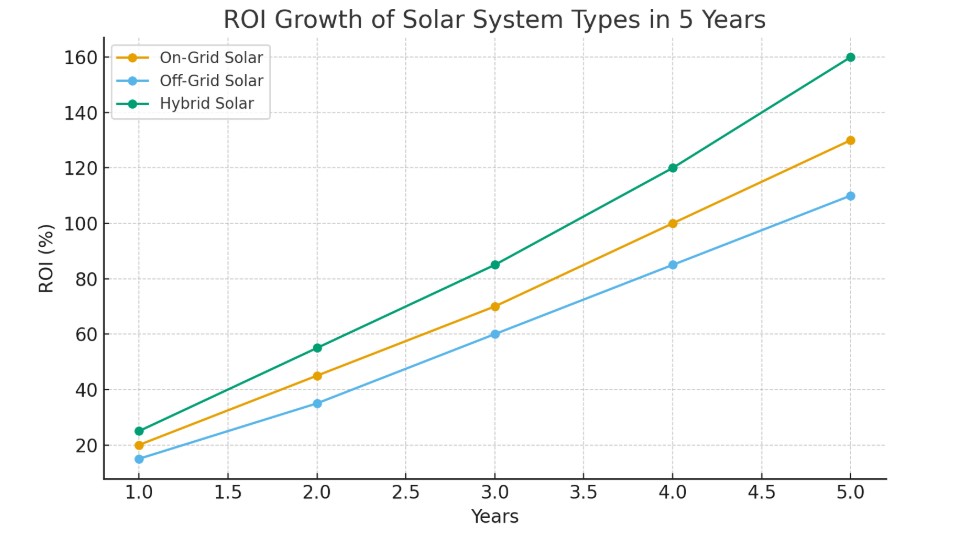
- On-Grid: Imagine your solar setup as a friendly neighbour, it shares what you produce with the electricity grid and borrows power when you’re short. Perfect for urban homes and businesses with stable grid connectivity.
- Off-Grid: Think of this as the independent mountain dweller. It doesn’t rely on the grid and stores excess power in batteries, ideal for rural or remote locations.
- Hybrid: The best of both worlds, connected to the grid but backed by a battery. Great for those who want resilience and reliability.
Step 3: Space, Shade, and Site Suitability
The best solar system is the one that fits perfectly, both technically and spatially. Start with a site assessment:
- Check roof orientation (south-facing is ideal in India).
- Ensure there’s minimal shading from nearby trees or buildings.
- Verify the structural strength of the roof.
A certified installer can conduct a shadow analysis and recommend the right panel angle for maximum sunlight absorption.
Bonus: Solar systems also extend your roof’s life by protecting it from direct heat exposure.
Step 4: Efficiency vs. Budget — The Performance Balance
Not all solar panels are created equal. When comparing panels, look at these key factors:
- Efficiency Rating: The higher, the better (18–22% is optimal).
- Temperature Coefficient: Panels that handle heat better perform more consistently in India’s hot climate.
- Warranty: Look for at least 25 years of performance warranty.
Chart: Comparison of Solar Panel Types
| Type of Panel | Efficiency (%) | Cost Range (₹/W) | Lifespan (Years) | Ideal For |
| Monocrystalline | 19–22 | 35–45 | 25–30 | Premium homes, offices |
| Polycrystalline | 15–18 | 25–35 | 20–25 | Standard households |
| Thin-Film | 10–13 | 20–30 | 15–20 | Large industrial roofs |
Step 5: Compliance, Security & Privacy in Solar Systems
With smart solar setups now connected to mobile apps and dashboards, data privacy and cybersecurity become essential.
- When applying for solar subsidies or net metering, ensure you meet legal and policy compliance using tools like Privacy Policy Generator. It helps ensure your website or application is transparent about user data and energy tracking.
- Protect your solar app dashboards and IoT logins with strong credentials using Strong Password Generator. A weak password could expose your energy data to unauthorized access.
- Manage installation communications and customer verification through secure email solutions like Nixxmail, especially useful during large-scale installations with multiple vendors.
Step 6: Calculate ROI — Because Every Ray Counts
Solar energy isn’t just a sustainability choice; it’s an investment. Here’s how you can estimate your returns:
Formula:
ROI (%) = (Annual Savings / Total System Cost) × 100
Example:
If a 5 kW system costs ₹3,00,000 and saves you ₹60,000 annually:
ROI = (60,000 / 3,00,000) × 100 = 20% annual return
Over 5 years, you’d recover your cost, and the rest of your system life is pure savings!
Chart: Average ROI by Solar Capacity in India
| Solar Capacity (kW) | Installation Cost (₹) | Annual Savings (₹) | Payback Period (Years) |
| 3 | 1,50,000 | 35,000 | 4.3 |
| 5 | 3,00,000 | 60,000 | 5.0 |
| 10 | 5,50,000 | 1,25,000 | 4.4 |
| 25 | 11,00,000 | 2,75,000 | 4.0 |
You can track your ROI and solar performance KPIs using advanced analytics platforms like Rankoq, which help measure your system’s energy yield, uptime, and performance trends.
Step 7: Choose the Right Partner
Finding the right solar provider is as important as picking the right panels. Look for:
- MNRE-approved installers
- BIS-certified equipment
- Strong after-sales service
Reputable companies like Greenshine Energies guide you through every step, from system design to subsidy documentation, ensuring a smooth and transparent experience.
Step 8: Sustainability Beyond Savings
Solar energy isn’t just about financial gain. It’s about reducing your carbon footprint and building a cleaner future.
By switching to solar:
- You reduce CO₂ emissions by 1.5 tons per kW annually.
- You contribute to India’s mission of 500 GW renewable capacity by 2030.
- You gain energy independence and resilience against grid failures.
Conclusion: Your Solar Journey Starts with a Smart Choice
Switching to solar isn’t just a home upgrade; it’s a lifestyle shift towards sustainability, efficiency, and future-readiness. Whether you’re lighting up your home or powering a business, the right solar system empowers you to control your costs, your impact, and your energy destiny.
So, the next time the sun shines, let it power more than your day. Let it power your future.